
Handicap Ada Parking Signs
Featured Products




About Our Handicap Ada Parking Signs
Ensure your facility meets legal standards and provides accessible access for all visitors with our selection of durable parking signage. These indicators are essential for marking designated spaces in commercial parking lots, hospitals, schools, and private business fronts, ensuring strict compliance with federal and local regulations. By clearly identifying reserved areas with high-visibility ADA parking signs, property owners help maintain an orderly flow of traffic while prioritizing safety and convenience for individuals with disabilities. Furthermore, installing effective property signs prevents unauthorized vehicle storage and demonstrates a professional commitment to inclusivity and organized site management.
- Built with heavy-duty, rust-proof materials to withstand harsh weather and resist fading.
- Features high-contrast reflective surfaces for maximum visibility during the day or night.
- Standardized designs ensure full compliance with current ADA and municipal code requirements.
- Pre-drilled mounting holes allow for quick and secure installation on posts, fences, or walls.
Understanding Core ADA Parking Sign Requirements
Ensuring your parking lot is compliant starts with understanding the federal standards set by the Americans with Disabilities Act (ADA). These rules are not merely suggestions; they are the minimum legal baseline for accessibility across the nation. Established to ensure equal access for individuals with disabilities, these regulations aim to provide clear, unmistakable guidance for drivers who require accessible parking. Failure to meet these federal standards can result in significant penalties, including federal fines and private lawsuits, making compliance an essential business practice.
Expert Tip: Non-compliance with ADA regulations can lead to fines ranging from $75,000 for a first offense to $150,000 for subsequent violations. Beyond financial penalties, it opens your business to potential civil litigation, making proactive compliance a sound investment.
The International Symbol of Accessibility (ISA)
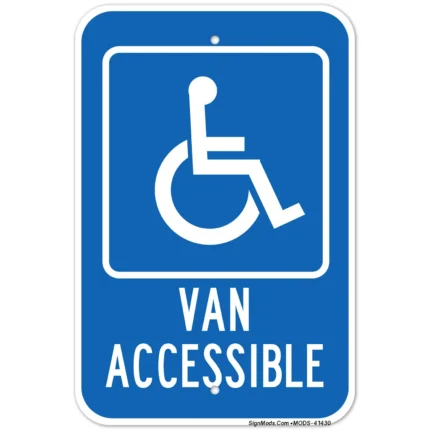
The most recognizable element of any Handicap Ada Parking Signs is the International Symbol of Accessibility (ISA). This symbol, featuring a stylized dynamic character in a wheelchair, must be prominently displayed on all signs identifying accessible parking spaces. The design is standardized for a reason: it provides immediate, universal recognition for drivers, regardless of their native language or familiarity with the area. To meet federal requirements, the sign must feature a white ISA on a high-contrast blue background, specifically Pantone Blue 294. This specific color combination ensures maximum visibility in various lighting conditions, from bright sunlight to overcast days.
Van Accessible Parking Signs: When Are They Needed?
The ADA requires that for every six accessible parking spaces (or fraction of six), at least one must be a van-accessible space. These spaces are wider than standard accessible spots to accommodate vehicles with side-mounted wheelchair lifts and ramps. A standard accessible car space requires an adjacent access aisle that is at least 5 feet wide, while a van-accessible space requires a wider access aisle of at least 8 feet. Consequently, these specific spaces must be clearly identified with a van accessible parking signs. This sign includes the standard ISA but adds the supplemental text "VAN ACCESSIBLE" to prevent confusion and ensure the space is available for those who need the extra clearance. Proper designation is not optional; it is a critical component of a compliant parking facility.
"No Parking" Signs for Access Aisles
Access aisles—the striped areas adjacent to accessible parking spots—are a crucial component of an accessible space. They provide the necessary clearance for individuals using mobility devices like wheelchairs or walkers to safely exit and enter their vehicles. These areas must be kept clear at all times. To enforce this, you must post an "Access Aisle - No Parking" sign. These signs often include explicit tow-away warnings and fine information to deter unauthorized vehicles from blocking this essential safety zone. The access aisle itself should also be marked with diagonal or chevron-style striping to visually set it apart from drivable pavement, further reinforcing that it is a no-parking zone. Neglecting to protect the access aisle renders the accessible parking space unusable and is a common source of compliance violations.
Now that the core sign types are clear, the next step is determining the exact quantity of accessible spaces your property needs to provide.
How Many Handicap Parking Spaces Are Required?
A common and critical question for facility managers is determining the correct number of accessible spaces for their parking lot. The ADA provides a clear, scalable formula based on the total number of parking spaces in your lot, which applies to both customer and employee parking areas. Following these guidelines is mandatory for any commercial or public facility, from small retail shops to large corporate campuses and medical centers.
Calculating Your Required Number of Spaces
The number of required accessible parking signs directly correlates with your lot's total capacity. Use this official ADA guideline to perform a quick audit and ensure your facility is compliant. The requirements scale as follows:
- 1 to 25 total spaces: 1 required accessible space
- 26 to 50 total spaces: 2 required accessible spaces
- 51 to 75 total spaces: 3 required accessible spaces
- 76 to 100 total spaces: 4 required accessible spaces
- 101 to 150 total spaces: 5 required accessible spaces
- 151 to 200 total spaces: 6 required accessible spaces
- 201 to 300 total spaces: 7 required accessible spaces
- 301 to 400 total spaces: 8 required accessible spaces
- 401 to 500 total spaces: 9 required accessible spaces
- 501 to 1000 total spaces: 2% of total spaces
- 1001 and over: 20 spaces, plus 1 for each 100 over 1000
Compliance Quick-Check: Remember the one-in-six rule: for every six accessible spaces provided, one must be a van-accessible space (
8-footwide access aisle). Outpatient facilities and medical centers have stricter requirements, often needing 10% of patient and visitor spaces to be accessible.
Having the correct number of spaces is only half the battle; proper installation of the signage is equally important for achieving full compliance.
How to Install ADA Parking Signs: Mounting Height and Placement
Correct installation is just as critical as having the right sign. An ADA-compliant sign mounted at the wrong height or in an obscured location is a violation. Improper placement can render a sign non-compliant, difficult to see for drivers, and unenforceable for property managers. Following best practices ensures your signs are visible, legally sound, and effectively reserve spaces for those who need them most.
ADA Sign Mounting Height Rules
According to federal ADA guidelines, ADA parking signs must be mounted so that the bottom edge of the sign is at least 60 inches (5 feet) above the ground surface or parking surface. This specific height is mandated to ensure the sign remains clearly visible over the hoods of parked vehicles, including larger SUVs and trucks. It also prevents the sign from being easily obscured by snowfall in colder climates. This 60-inch rule applies whether the sign is mounted on a dedicated post, a wall, or another permanent structure at the head of the parking space.
Installation Warning: The
60-inchmeasurement is taken from the ground to the bottom of the sign, not the middle or top. This is a common installation error that can lead to a compliance failure. If a sign is placed along a pedestrian walkway and not in the vehicle overhang zone, the bottom edge should be no more than80 incheshigh to prevent it from being a head-level hazard.
Proper Placement for Maximum Visibility
The sign should be located at the head of the parking space, typically centered to be immediately visible to a driver pulling into the spot and to parking enforcement officials. Avoid placing signs where they might be hidden by landscaping, building columns, or other architectural features. The goal is unambiguous identification. For post-mounted signs, using a sturdy U-channel post is recommended. For wall-mounted applications, ensure the sign is flush and securely fastened. The placement must guarantee that the sign is not blocked by a vehicle parked in the space or by the operation of a wheelchair lift.
With the rules for placement and quantity covered, choosing the right physical sign is the final piece of the compliance puzzle.
Choosing the Best Materials for Your Handicap Parking Signs
The durability of your signage is crucial for long-term compliance and cost-effectiveness. Outdoor signs are constantly exposed to the elements—sun, rain, snow, and wind—as well as potential minor impacts or vandalism. Investing in high-quality materials is not an expense but a smart business decision that ensures your signs remain legible, reflective, and structurally sound for years, reducing the total cost of ownership and maintaining a professional appearance for your property.
Why Reflective Parking Signs Are Essential for Compliance
Visibility is a key pillar of ADA compliance, and it doesn't end when the sun goes down. Reflective parking signs are critical for ensuring legibility in low-light conditions, such as at night, during storms, or within dimly lit parking garages. Engineer Grade reflective sheeting is the industry standard for these applications, as it meets ASTM D4956 standards for reflectivity. It illuminates brightly when struck by vehicle headlights, making the sign easy to read from a distance without the intense, distracting glare that higher-grade materials can produce. A non-reflective sign becomes nearly useless at night, failing to properly reserve the space and creating a compliance risk.
Durable, Rust-Proof Aluminum: The Industry Standard
For outdoor handicap parking signs, heavy-duty, rust-proof aluminum is the superior material choice. Unlike plastic signs that can crack and fade or steel signs that can rust, aluminum is lightweight for easy installation yet exceptionally strong. Our signs are made from robust .080" thick aluminum, which resists bending, corrosion from rain and humidity, and damage from minor impacts. This ensures a long, maintenance-free service life. To simplify the installation process, all our signs also come with pre-drilled mounting holes that align with standard posts, saving you time and labor costs.
While federal ADA rules create a strong foundation, full compliance requires checking for additional local regulations.
Navigating State-Specific Parking Sign Requirements
While the federal Americans with Disabilities Act provides a national standard, it's crucial to understand that this is the minimum requirement. Many states, counties, and local municipalities have enacted their own, often stricter, regulations for accessible parking. It is absolutely vital for business and property owners to check local laws to ensure full compliance and avoid fines, as simply meeting the federal standard may not be enough.
Legal Warning: Always prioritize local regulations. Failing to meet a state-specific requirement, such as displaying a particular fine amount or using a unique sign design, can lead to a violation notice and penalties, even if your signs appear to be federally compliant. Ignorance of local codes is not a valid defense.
Common State Variations to Watch For
Some states have unique requirements that go beyond the federal rules. These variations are non-negotiable and must be followed within that state's jurisdiction. Common differences include:
- Specific Fine Amounts: Many states, such as California and Florida, require the exact penalty for illegal parking to be printed directly on the sign (e.g., "MINIMUM FINE $250"). This serves as a stronger deterrent.
- Tow-Away Language: Some jurisdictions mandate specific wording about towing unauthorized vehicles at the owner's expense. New York, for example, has particular requirements for its tow-away zone signage associated with accessible parking.
- Unique Sign Designs: A few states have their own official sign designs that must be used instead of, or in addition to, the standard federal ISA sign. California's R99C sign is a well-known example that must be posted in addition to the federal blue sign.
Navigating these variations can be complex, but it is a necessary step. At Signmods, we take the guesswork out of compliance by offering a comprehensive collection of state-specific parking signs designed to meet the precise legal requirements of your location, helping you get it right the first time.
